T+1 in Europe

Global Markets: How to prepare for T+1 settlement in EEA, UK & Switzerland
Last year, EU, UK & Swiss regulators announced the reduction of the standard settlement cycle for securities transactions to one business day after the trade date (T+1), effective 11 October 2027.
2026 is a pivotal implementation year for T+1, as firms turn new requirements into day-to-day operating changes. This article outlines what to expect as the market moves to T+1, including our approach and key suggestions to facilitate the transition ahead of go-live.
Overview
Product Scope Regulatory- Transactions executed on multilateral venues in transferable securities
| Market Scope
| Industry Resources |
| Beyond regulatory scope, indirect impacts are expected on OTC Securities, Exchange & OTC Equity derivatives, Equity Swaps & Securities Financing Transactions. | ||
| Key Market Deadlines | EU | UK | CH |
| Allocations, Confirmations | 23:00 CET on T0 | 23:59 UK time on T0 | |
| Settlement Instruction submission | 23:59 CET on T0 | 05:59 UK time on T+1 | 23:15 CET on T+1 |
| DVP cut-off | EUR 16:00 CET | GBP 15:45 UK time | CHF 17:00 CET |

Main T+1 Considerations
Move to T+1 will require shortening certain processes and extensively modifying some others.
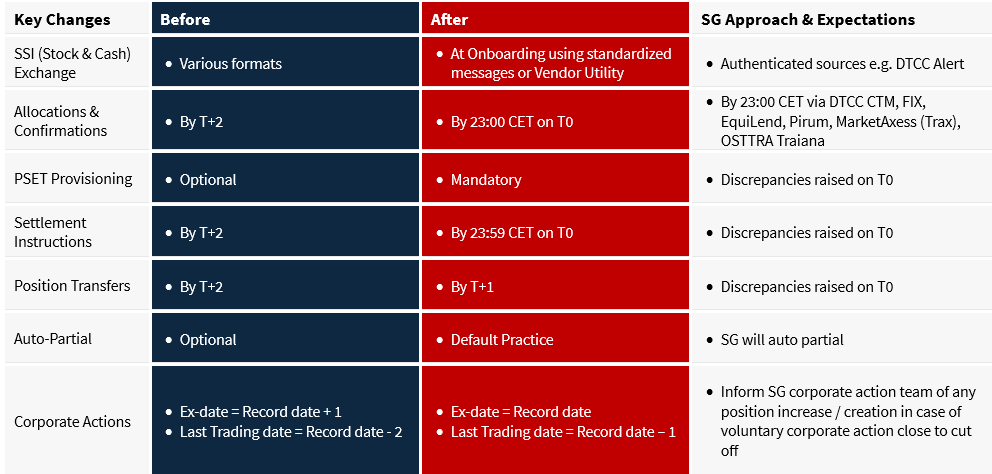
Framework for meeting T+1 regulatory objectives
A. On Trade Date (T0): Accurate and timely instructions
Send Allocations & Confirmations with Place of Settlement (PSET) from 7th Dec 2026
Provisioning PSET will be mandatory in all allocations and confirmation
Complete trade allocations and confirmations no later than 23:00 CET on T0
Use electronic matching platforms as soon as trades are booked
Provide complete and accurate settlement instructions
Ensure referential data quality as T+1 will stress ‘just in time onboarding’ chains, wherein accounts not correctly set up ahead of trading would result in significant settlement risk
Share SSI’s only via authenticated sources such as DTCC ALERT. Alternatively, use our Digital SSI self-service offering on SG MARKETS. Note, our policy considers SSIs shared via emails as ‘un-authenticated’ triggering a callback process which delays the update of SSI in our referential, impacting timely settlement
Raise & resolve all discrepancies from T0 based on pre-matching instructions sent on T0
B. On T+1: Settle as much position as possible
Auto Partial as much as possible. Societe Generale intends to align with the regulatory recommendation to partial as a default standard for all securities transactions.
Anticipate position transfers as early as possible according to all the relevant cut‑off times to ensure sufficient cash & securities provisions in the accounts to allow trade settlement.
C. Manage settlement risk on Corporate Actions
Communicate any intention to buy or increase positions, particularly close to corporate action deadlines, to allow appropriate checks with custodians and mitigate risk of instruction rejection.
Raise any security settlement related issues impacting corporate actions elections as soon as detected, and before the response deadline.
D. Monitor market practice evolution
Anticipate potential other products transitioning to T+1 to align with the settlement cycle of underlying securities in the impacted markets. Societe Generale intends to follow industry standards and default the settlement cycle of the following products to T+1:
Securities traded bilaterally (OTC)
Equity Swaps
Equity Derivatives on eligible transferable securities
Clients are requested to notify their usual Societe Generale representative at an early stage if a transaction is expected to settle outside the default T+1 settlement cycle.
Societe Generale is also actively following and participating in the industry guideline definition, particularly in the following areas, updates for which will be communicated in due course:
Securities Lending
ETF Primary Creations & Redemptions
Bond derivatives (bond futures) traded on venues - Societe Generale awaits the guidance from trading venues and central clearing counterparties (CCPs)
Prime Brokerage
E. Plan internal & industry testing in Q1-Q2 2027
Testing is key to ensure successful transition, plan internal testing as early as possible.
Societe Generale monitors key FMI’s updates for testing platform availability, connectivity & use cases that may affect the current T+1 Industry committee testing windows.
Conclusion: Key Takeaways
Share SSIs (stock & cash) at onboarding using authenticated sources (i.e. DTCC Alert)
Complete trade allocations and confirmations by 23:00 CET on trade date (T0) using electronic platforms
Ensure PSET is accurately communicated on trade date (T0) starting 7 December 2026
Continue providing complete and accurate trade instructions, anticipate & initiate position transfers as soon as possible
Market practices for securities lending and ETFs may evolve following industry dialogue and will be communicated by Societe Generale in due course
Engage with us early to discuss exceptions to the default settlement cycle on OTC products (securities, equity swaps, or derivatives) or constraints specific to your operating model.
The success of T+1 transition relies on all the market participants readiness, including both of us.
If you have any questions, reach out to us or to your usual Societe Generale contact to discuss how we can support you in implementing the necessary changes as we progress towards the transition. We look forward to continuing the dialogue in the months leading up to the transition.
Disclaimer
This document has been prepared by Societe Generale (SG). The information it contains is general and does not constitute advice. It was prepared based on information available to SG as of the date it is sent and may not reflect subsequent market developments. It contains information on T+1 settlement reform that is intended for the use of SG clients only and it should not be shared with third parties. Names of other companies, products or services appearing in this publication are trademarks or service marks of their respective owners and such owner shouldn’t be liable for the information contained herein. The use of these products or service may require entering into a prior agreement with the provider. SG accepts no responsibility or liability to you with respect to the use of this document or its contents. Recipients should not rely solely on this material and are strongly advised to consult independent professional for advice (legal, tax, accounting, financial or other).