Cocoa market: towards more flexible financing amid price volatility

Amid unprecedented volatility in cocoa prices, industrial players are seeking more flexible financing solutions to manage working capital and strengthen liquidity.
Societe Generale supported Barry Callebaut with an innovative EUR 2 billion borrowing base facility backed by cocoa inventories, illustrating how asset-based financing can help companies adapt to fast-changing commodity market conditions.
Cocoa prices rose from around USD 4,400 per ton to over USD 12,000 in 2024, before falling back to below USD 3,000 in early 2026, illustrating extremely rapid and significant variations1.
The global cocoa market has indeed experienced exceptional volatility recently, driven by supply constraints, climate-related disruptions and critical imbalance between production and demand. In this uncertain environment, industrial players must contend with rapid and significant price fluctuations, which directly impact their financing needs and working capital management. Their ability to efficiently finance inventories whose value fluctuates significantly has become a strategic priority.
A need for more dynamic financing solutions
In response to these challenges, greater flexibility has become essential in an environment where the value of underlying assets - such as cocoa inventories and hedging-related margin calls - can vary significantly over short periods. This requires financing structures that can adapt efficiently to changing market conditions and support business growth.
The development of more dynamic financing solutions, directly indexed to assets and market conditions, appears therefore to be a necessary evolution for all players with significant exposure to commodities.
An innovative transaction for Barry Callebaut
Societe Generale acted as Active Bookrunner, Mandated Lead Arranger and Letter of CreditIssuing Bank in an inaugural EUR 2 billion Sustainability-linked borrowing base facility for Barry Callebaut, the world’s leading manufacturer of cocoa and chocolate products. The Bank played a key role in structuring the transaction and ensuring the successful syndication of the facility.
Backed by cocoa inventories, this financing solution stands out for its capacity to adjust to fluctuations in commodity prices. Structured in several tranches, it includes indexation mechanisms enabling the level of financing to adapt to market conditions. In addition, the facility can be used in the form of guarantees to cover margin calls, thereby limiting the use of Barry Callebaut’s liquidity. By directly linking financing to the value of its inventories, Barry Callebaut strengthens its liquidity flexibility and its ability to absorb the effects of volatility.
Towards a broader adoption of asset-backed, commodity financing
This transaction illustrates a broader evolution in financing practices in the commodities sector. Such a structure has until now been mainly used in asset-intensive sectors (retail, commodity trading, transportation, energy, etc.) where large volumes of receivables, inventories or reserves can be reliably monitored and valued.
It paves the way for more flexible and robust financing models, better aligned with the operational realities of sector players. It could therefore serve as a benchmark for other companies facing similar challenges, particularly in the agri-food sector.
1 Source : Intercontinental Exchange Futures US.
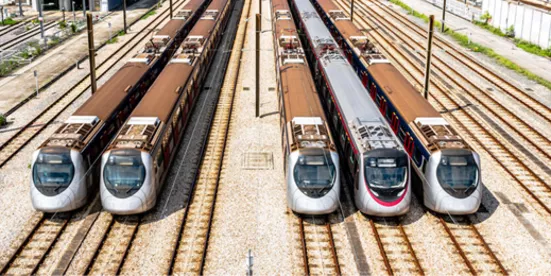
A EUR 175 million ICIEC‑covered financing supports the Bandırma–Bursa–Yenişehir–Osmaneli High‑Speed Railway project in...

A video interview with Lénaïg Trénaux, Global Co-Head of Energy, Mining and Industries and Head of Sustainable and...

法国兴业银行是一家领先的欧洲银行,拥有逾126,000名员工,在全球65个国家和地区为约2,500万客户提供服务。过去160年来,我们一直助力经济发展,为企业、机构和客户提供各类增值性咨询和金融解决方案。 ...

Offering a full range of finance and advisory services supported by a strong sectorial expertise.