Global Markets Conference 2026

Geopolitical fragmentation, public-debt pressures, euro area inflation and shifts in capital markets are among the forces reshaping the global economic and financial landscape in the latter half of 2026.
These dynamics were at the heart of Societe Generale’s flagship Global Markets Conference, held on 7 October in London and bringing together investors, policymakers and market experts. As investors navigate this changing landscape, understanding the outlook increasingly depends on distinguishing structural shifts from temporary shocks.
Conference highlights
Hear from our speakers
Q&A with General Lloyd Austin, 28th U.S. Secretary of Defense (2021-2025)
Q&A with Lord Mervyn King, Former Governor of the Bank of England (2003-2013)
Explore five key themes shaping investor discussions at the Global Markets Conference 2026
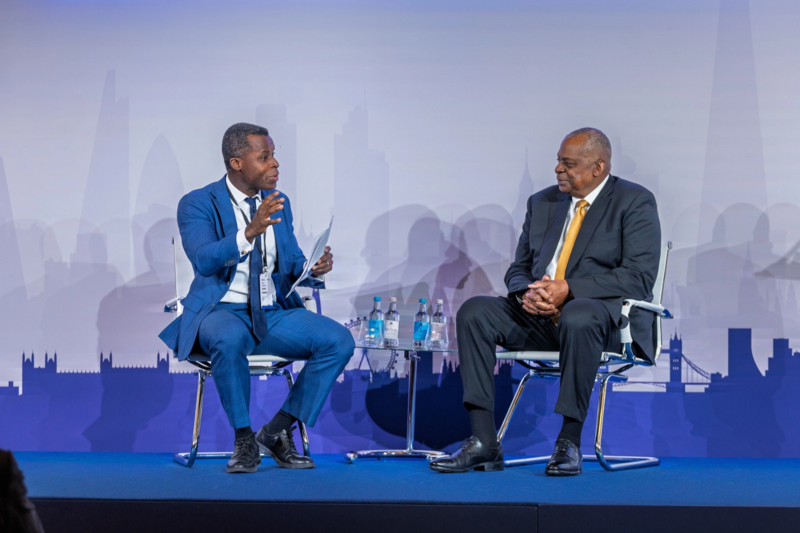
Kokou Agbo Bloua, Global Head of Economics, Cross Asset & Quant Research & General Lloyd Austin, 28th U.S. Secretary of Defense (2021-2025)
Geopolitical tensions are increasingly intertwined with energy security, trade flows and economic resilience. Conflicts and strategic competition can affect critical infrastructure, shipping routes, energy supplies and the cost of moving goods far beyond the countries directly involved.
Maritime chokepoints show how even the threat of disruption can raise insurance costs, lengthen transport routes and increase uncertainty around key resources. Alternative supply routes and infrastructure investment may reduce particular dependencies, but cannot eliminate exposure.
Strategic alliances are also evolving. Competition between the United States and China remains an important consideration for the international order, while questions around security commitments, deterrence and cooperation continue to shape the geopolitical landscape. In Europe, strengthening defence capabilities, expanding industrial capacity and improving interoperability are increasingly important to the region’s security architecture.

Phoenix Kalen, Global Head of Emerging Markets Research & Lord Mervyn King, Former Governor of the Bank of England (2003-2013)
Governments must retain the capacity to respond to future shocks while meeting longer-term spending needs, including defence and infrastructure. High debt burdens and borrowing costs can constrain that flexibility, making fiscal sustainability central to the medium-term outlook.
Periods of stability offer an opportunity to rebuild fiscal capacity. Stronger productivity could support output and public revenues, but uncertain potential gains do not remove the need for sustainable public-finance decisions.
Fiscal pressures are closely connected to monetary policy. Central banks are now looking to distinguish temporary price increases, including those caused by energy or geopolitical shocks, from persistent inflation while maintaining the credibility of their targets. Clear communication can explain uncertainty, but credibility ultimately rests on policy decisions.
The interaction between public borrowing and monetary policy also raises the risk of fiscal dominance, where government financing needs constrain the pursuit of price stability. The key question is not the level of debt alone, but whether fiscal pressures limit monetary authorities’ ability to fulfil their mandate.
The euro area outlook depends not only on the scale of energy and commodity-price shocks, but also on how they spread through the economy. The key distinction, however, is between temporary changes in relative prices and pressures that become embedded in prices, wages and expectations.
The experience of 2022 showed how an energy shock can become more persistent when supply-chain disruption and strong demand lead firms to adjust prices more frequently and pass on costs across sectors. Monitoring this transmission helps distinguish a short-lived shock from a broader inflationary process.
Wages are also another important factor. Pay increases may restore purchasing power, but a wage-price spiral can emerge if wages and prices reinforce one another amid expectations of persistently high inflation. Wage settlements, firms’ pricing behaviour and inflation expectations therefore need to be assessed together.
The composition and persistence of inflation matter as much as the headline rate. Energy shocks, wage dynamics, fiscal developments and domestic price pressures have different implications for monetary policy, interest-rate expectations and financing conditions.
Private and public credit markets have distinct risk, return, pricing and liquidity characteristics. The central question is not which is inherently superior, but whether the strategy and liquidity profile suit the underlying assets and the investor’s time horizon.
As the credit cycle normalises, defaults and differentiation between borrowers may increase without necessarily signalling a systemic crisis. The more important issues are capital-structure sustainability, underwriting quality and borrowers’ ability to service or refinance debt as interest rates remain higher.
Competition for opportunities can compress lending margins and creditor protections, encouraging optimistic assessments of credit quality. Transparency, realistic valuations and rigorous borrower-level analysis remain essential to identifying risks that headline returns may obscure.
Liquidity is central. Private credit often involves assets held over longer periods, allowing lenders to focus on cash flows and credit quality, but investors may be unable to exit quickly or without affecting price. Product design and redemption terms must therefore reflect the liquidity of the underlying assets.
Europe presents both complexity and opportunity. Jurisdictional differences make assessment more demanding, while alternative financing can support businesses when bank lending or transaction activity is constrained. Outcomes depend on borrower fundamentals, cash flows, capital structures and lending terms rather than broad regional comparisons.
Across private and public markets, the priority is to match capital to risk, maintain underwriting discipline and ensure that liquidity arrangements reflect the assets being financed. These principles remain essential to sustainable long-term returns and resilient financing structures.
Artificial intelligence has implications for productivity, capital allocation, credit markets and national security. Its potential to improve efficiency and support innovation is significant, but the timing and scale of its benefits remain uncertain.
Productivity gains will depend on how quickly businesses integrate AI and redesign processes. Adoption will be uneven, and Europe’s opportunity rests partly on turning technological advances into practical improvements in output and competitiveness rather than treating higher productivity as guaranteed.
Investment in data centres and supporting technologies is reshaping capital allocation, creating financing opportunities while raising questions about valuations, leverage and the sustainability of capital expenditure. Technological disruption may also affect business models and debt-servicing capacity, making disciplined assessment of borrowers’ ability to adapt essential.
AI is also changing the strategic and security landscape. Autonomous systems and AI-enabled military capabilities could accelerate decision-making and alter the balance between offensive and defensive capabilities. Human oversight, reliable information, safeguards and international cooperation will be critical to managing these risks while preserving the technology’s potential benefits.

Par Raphael Vialat, Responsable Solutions de Financement Durable et à Impact Positif pour l’Asie-Pacifique chez Société...

Geopolitical fragmentation, public-debt pressures, euro area inflation and shifts in capital markets are among the...

Par Selina Cheung, Responsable des marchés de capitaux actions, Asie-Pacifique, Société Générale

La digitalisation et l'intelligence artificielle peuvent-elles enfin moderniser le trade finance tout en préservant la...

Par Wei Yao, Chef Économiste Groupe et Responsable de la Recherche Asie-Pacifique, Société Générale